Cron Jobs for Bots
You can add a cron job for your bot so it can automatically run from a schedule. This means you can set a repeatable time for the bot to automatically every minute, day, other month, etc.
To add a scheduled timer for your Bot
- Navigate to your Bots Page
- Click on the Bot you would like create a Cron Job for
- Click on the name of the Bot
- When you click on the Bot's name and open up the page, you should see the url similar to this
https://app.medplum.com/Bot/<botId>
- When you click on the Bot's name and open up the page, you should see the url similar to this
- Click on the Edit Tab
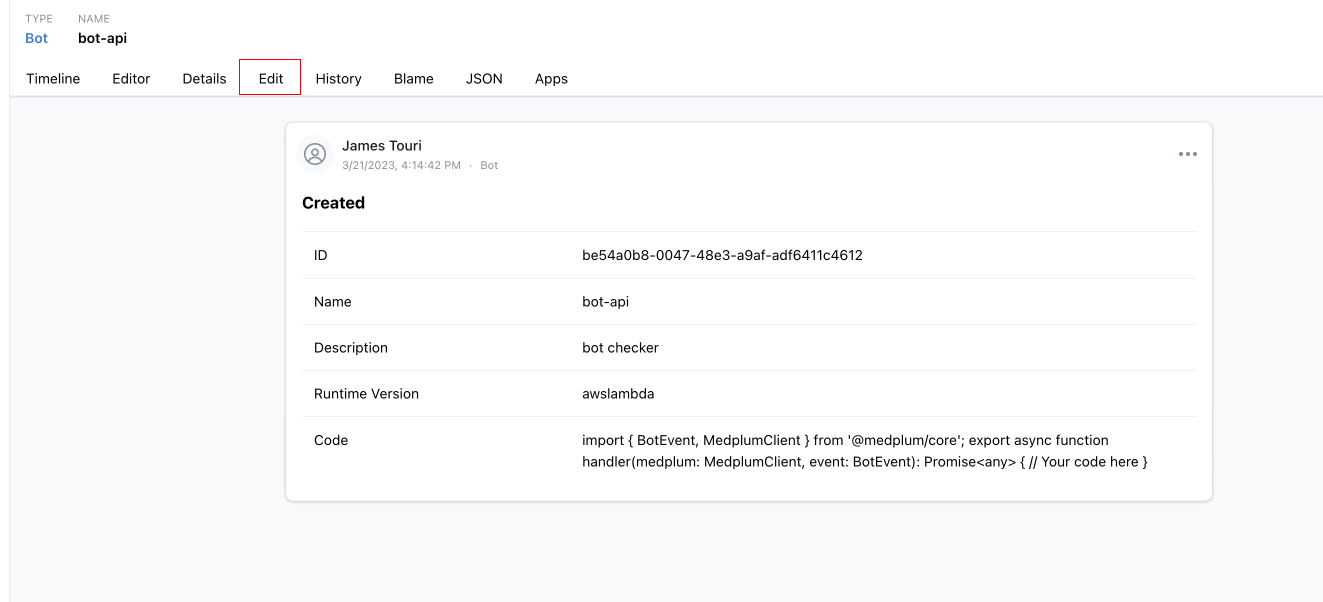
The Edit Form
In the Edit Form, scroll down to the Cron and choose one of the two ways to create a cron job. One as a UI tool, or a direct Cron format e.g * */3 * * *.
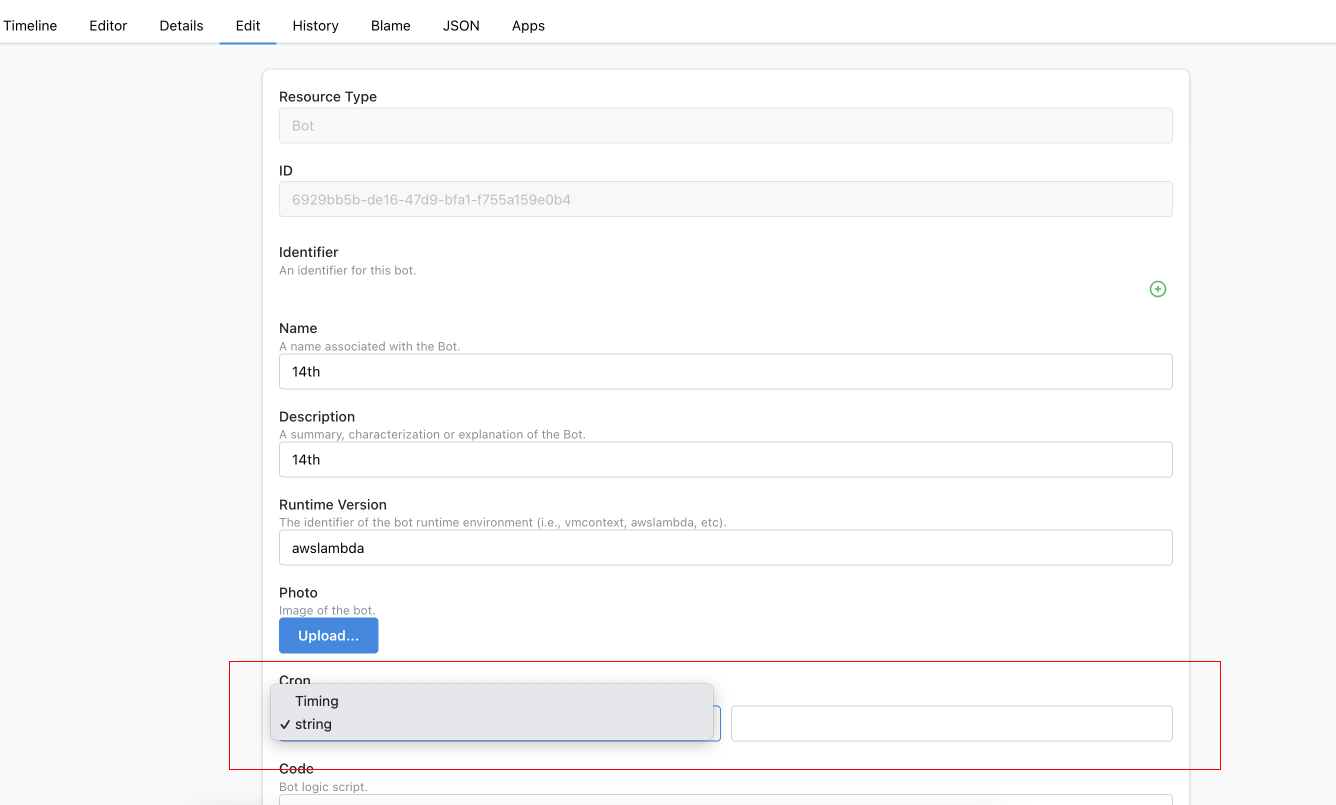
Click Ok in the bottom of the page, and your bot will be added to the queue.
Scheduling with the Cron resource
A Cron resource owns a schedule independently of the Bot, so the
same Bot can run on several schedules, each under a different identity and with different input.
Requires the cron project feature.
| Element | Meaning |
|---|---|
active | Only an active job is scheduled. Setting it to false unregisters the job but keeps the schedule. |
onBehalfOf | The ProjectMembership whose identity and access policy the run assumes. |
targetReference | The Bot to execute. |
cronString | The schedule, as a five-field cron expression. Required. |
endTime | The point after which the job stops running. |
parameter | Input for the Bot, which always receives the whole Cron resource, parameters included. |
{
  "resourceType": "Cron",
  "active": true,
  "cronString": "0 */3 * * *",
  "endTime": "2026-01-01T00:00:00.000Z",
  "onBehalfOf": { "reference": "ProjectMembership/<membershipId>" },
  "targetReference": { "reference": "Bot/<botId>" },
  "parameter": [{ "name": "region", "valueString": "us-east" }]
}
Writing a Cron whose cronString is not a valid cron expression is rejected, so a broken schedule
surfaces as an error on the request rather than as a job that silently never fires. The same applies
to targetReference and onBehalfOf: a reference the author cannot read is rejected on write,
rather than becoming a job that fails on every tick. Authoring a Cron is a project-administrator
capability, since it chooses the identity the Bot runs as.
Running a Bot from a linked project
A Bot is code, not authority, so targetReference may name a Bot in a
linked project while onBehalfOf may not. That is what
lets a shared project publish a Bot once and each customer project schedule it:
- The
Cronand itsonBehalfOfProjectMembershiplive in the customer project, which needs both thecronandbotsfeatures.onBehalfOfcan never name a membership in another project, linked or not — it chooses the access policy the run assumes, so allowing it would let one project borrow another's privileges. - The Bot lives in the shared project, which the customer project must link to. If the shared
project sets
exportedResourceType, it has to includeBot. The shared project does not itself need thebotsfeature to publish a Bot others run — that feature is checked againstonBehalfOf's project, since that is where the run executes — but it does need it to deploy one. - The customer project still needs a
ProjectMembershipof its own for that Bot to pointonBehalfOfat.
The Bot therefore runs with the customer project's access policy, reading and writing the customer's
data, and its secrets are the shared project's overlaid with the customer's. The execution
AuditEvent and the recorded Bot input both belong to the customer project — that is the identity
the run assumed, and the input is the customer's data — so the publishing project sees its Bots'
outcomes through server logs and bot execution metrics instead.
A job that can no longer run stops itself on its next tick rather than failing indefinitely.
Revoking the link, deleting the target Bot, and deleting the onBehalfOf ProjectMembership each
unregister it. Removing the cron feature only pauses it, so restoring the feature resumes the
existing schedule.